Editorial comparison
HFM vs Eightcap: trading workflow, Raw commissions and a cost example
Manage orders in HFM WebTrader or connect an Eightcap account to TradingView? A practical comparison of account choices, commission for 0.10 lot and an example separating commission from spread.
Start with the screen you use to place orders
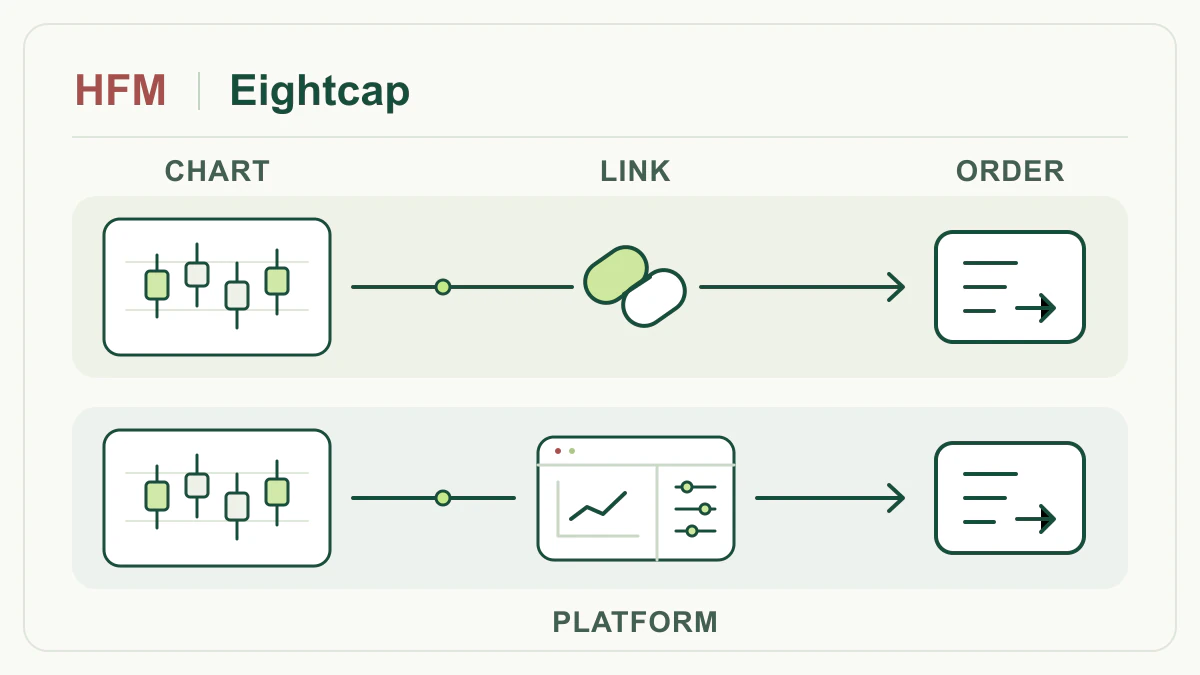
Someone comparing HFM and Eightcap may see TradingView mentioned on both websites, but the workflow differs. HFM offers its own WebTrader with integrated TradingView charts. Eightcap describes a designated trading account linked to TradingView through the broker list, allowing orders to be placed and managed there.
Start with how you work: do you want to trade inside TradingView, use MetaTrader or operate in the broker’s browser interface? Then select pricing that fits that platform. This reduces the chance of choosing an account from a commission headline and discovering that it is not configured for the connection you need. For company details, see the HFM review and Eightcap review.
Account map: what is being compared and in which units
These figures concern forex. Commissions are calculated for a USD account and a completed trade with opening and closing legs. At Eightcap, Raw on TradingView depends on the entity and the choices displayed when opening the account.
Scroll the table horizontally to read every column.
| Item |  HFM |  Eightcap |
|---|---|---|
| Pricing without a separate execution commission | Premium: spreads from 1.4 pips; Pro: from 0.6 pips | Standard: spreads from 1.0 pip |
| Commission pricing | Zero: variable spreads from 0 pips | Raw: spreads from 0 pips |
| Commission for 1 lot, 100,000 units | Zero: $6 round turn | Raw: $7 round turn |
| Commission for 0.10 lot | $0.60 round turn | $0.70 round turn |
| TradingView use | Charts inside HFM WebTrader | Connection through a designated TradingView trading account |
Spread figures are advertised “from” values. The table does not measure average spreads or execution quality.
A one-dollar difference per lot: what it means
HFM Zero’s forex table lists $6 for opening and closing 100,000 units, equivalent to $3 per side. Eightcap Raw lists USD $3.50 per side per standard lot in a USD account, giving $7 for a completed trade. At 0.10 lot, commissions are $0.60 and $0.70 respectively: a difference of 10 cents in commission alone.
You can multiply that difference by planned volume to understand its budget impact without changing trading frequency because of it. For example, ten completed 0.10-lot trades generate total commission of $6 or $7. Spreads, slippage and financing are excluded from that calculation. An account denominated in another currency also requires its corresponding commission tariff.
Worked example: a different spread can offset the commission
Assume a hypothetical 0.10-lot EUR/USD trade in a USD account. That is 10,000 euros; one pip, a 0.0001 change in EUR/USD, is worth $1. For illustration only, assume a 0.3-pip spread at HFM Zero and a 0.2-pip spread at Eightcap Raw. The trade opens and closes with unchanged market quotes within each account, without slippage, currency conversion or crossing rollover. The spread is counted once for the completed trade.
At HFM, spread cost is 0.3 × $1 = $0.30; round-turn commission is $0.60, giving $0.90 in total. At Eightcap, spread cost is 0.2 × $1 = $0.20, plus $0.35 on opening and $0.35 on closing, also giving $0.90. If both assumed spreads were 0.2 pips, the totals would be $0.80 and $0.90. All spreads in this example are invented; the trading cost guide explains how to substitute account data.
The HFM commission here is for the full round turn; its Zero MT4/MT5 announcement describes charging it entirely at opening. The $3-per-side equivalent does not promise two separate debits.
TradingView: configure the right account
Eightcap instructs users to select a trading account configured for TradingView, sign in to an existing TradingView account or create one if needed, then choose Eightcap in the Trading Panel and connect with the appropriate trading account credentials. Its current page describes Standard or Raw choices subject to entity and registration options. Do not assume that every existing MetaTrader account connects automatically or that Raw is available to every visitor.
HFM describes entering WebTrader through its client area and using integrated TradingView charts. This documentation does not verify selecting HFM as a broker inside tradingview.com. For someone with an established TradingView workspace, this distinction may matter more than a small commission difference. Someone who prefers a browser interface within HFM may find the embedded charts sufficient.
Mobile access, balances and reports: where each task happens
HFM describes synchronisation between its app and WebTrader, with an existing trading account accessible through the browser interface. This is relevant to someone who starts analysis on a computer and continues monitoring on a phone. Before relying on that workflow, practise viewing an open order and its history on both screens in a demo, checking that the same account is selected.
Eightcap explains that deposits and withdrawals are handled in the Eightcap account area even when trading through TradingView. Complete account history is available under Reports there. Separate interfaces need not be a problem, but they change the workflow: analysis and execution in TradingView, funding and reports with the broker. A shared login does not establish automatic movement of balances or positions between platforms.
What else contributes to cost beyond Raw commission
Spread is the difference between the buying and selling prices. It varies, and an advertised starting spread of 0 pips does not guarantee a zero spread when an order is placed. Holding costs also need checking: HFM limits swap-free treatment to particular instruments and conditions. Eightcap describes swap as a debit or credit for positions held beyond rollover. This article supplies no single numeric overnight rate applicable to every pair.
For a multi-day trade, record the direction and number of nights before comparing results. Anyone funding in a currency different from the account currency should also establish the conversion method and cost. For useful tracking, keep execution commission, spread, holding and conversion separate in the report; execution price and slippage remain a separate item to examine.
A minimum deposit is not a risk budget
Eightcap’s account page displays a $100 minimum deposit. HFM Zero’s specification table states $0, while the FAQ on the same page states $25. That inconsistency remains unresolved, so there is no basis for choosing between the brokers on an unqualified promise that Zero requires no deposit. Even the absence of a deposit requirement would not mean a trade can be opened without sufficient margin.
Both accounts show a 0.01-lot minimum trade size. For EUR/USD with a 100,000-unit contract per lot, this means 1,000 euros, while 0.10 lot means 10,000 euros. Choose volume using stop distance and intended risk with the position-size calculator. Account funding and trade exposure are different quantities, and a stop does not guarantee a maximum loss.
Choose around the work you do every day
Eightcap merits consideration if direct execution in TradingView is essential and you are prepared to select an account configured for it and check which pricing options are available. The practical limitations are the required account configuration and Raw commission being added to spread. HFM merits consideration if you prefer MetaTrader or its WebTrader and want to choose between Zero, Premium and Pro. A user requiring an HFM connection from within TradingView still has no verification of that connection in the reviewed source.
Open the HFM and Eightcap comparison, then practise moving from chart to order to report in a demo. Compare the same pair and volume before interpreting prices. Contract terms depend on the entity and residence; website language does not determine eligibility. Leveraged CFD trading carries a significant risk of loss.