Editorial comparison
TradingView vs TrendSpider: charts, strategy research and alerts
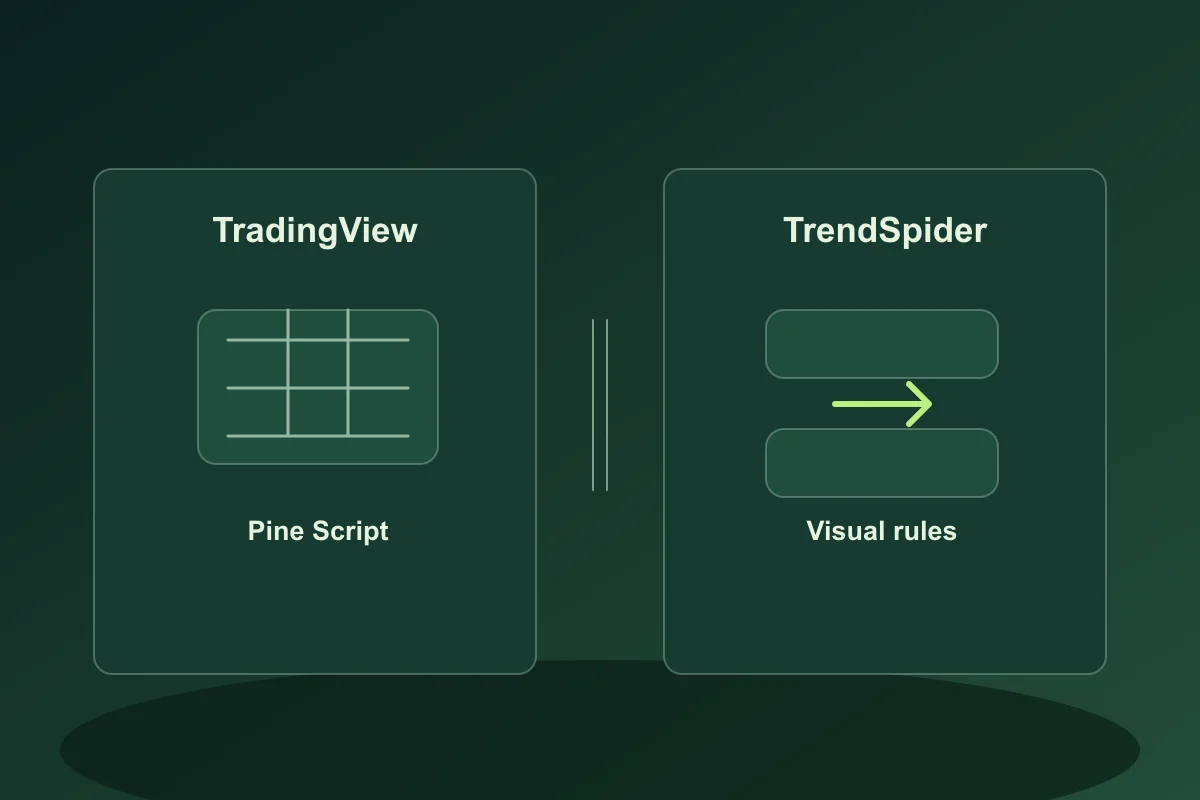
TradingView and TrendSpider support market research through different workflows. TradingView provides charts and Pine scripts, while TrendSpider emphasises visual condition building and testing. The choice depends on whether you need custom logic, a research experiment without coding, or a structured way to monitor a defined set of opportunities.
Start with the task rather than the tool count
Both services provide software for research and trading workflows; neither subscription is itself a brokerage account. Drawing an order on a chart or receiving an alert does not establish that a live order was sent. Separate market data, the testing engine, alerts and the execution connection.
A user maintaining Pine code begins from a different position from someone who wants to assemble entry and exit conditions visually. TrendSpider's Strategy Tester supports visual condition construction without writing code. That does not mean it can express every strategy or that automated testing makes a trading idea profitable. The TradingView review covers the broader product before this narrower workflow comparison.
Compare the research process
Scroll the table horizontally to read every column.
| Stage |  TradingView | TrendSpider |
|---|---|---|
| Define custom logic | Pine and the relevant scripting capabilities | Conditions in the visual Strategy Tester |
| Test historical behaviour | Simulation engine with cost and fill settings | Visual tester subject to data and usage limits |
| Run parallel research | Charts, alerts and plan capacities | Workspaces, scanners and alerts by plan |
| Move toward execution | Trading connection or separate external service where required | Connection and routing service, including an applicable SignalStack arrangement |
This compares methods rather than declaring an accuracy winner. A larger subscription can increase parallel capacity without improving the idea being tested. If most of the work is manual chart reading, buying unused testing capacity does not automatically save time.
Custom code versus visual conditions
Pine lets users express rules and test them inside TradingView. A useful advantage is explicit logic and identifiable versions, but the user must understand the script, its calculation timing and the difference between information available at the time and information visible retrospectively. A public script can be educational without providing evidence of a successful trading method.
TrendSpider's visual interface can reduce the coding burden, while still requiring precise decisions about when a condition is evaluated and what constitutes an entry or exit. Its Strategy Tester documentation also distinguishes supported test assets. A chart or options-data display does not prove that the same asset can be backtested in that engine; the documentation excludes indices and options-data backtests.
Run the same experiment on both platforms
Choose the same instrument, timeframe and historical period. Write the rule in ordinary language before building it: for example, evaluate a condition at bar close and enter at the next point permitted by the engine. Specify commission, a slippage assumption and the exit convention in advance. Inputs should describe the experiment rather than be adjusted to make the results attractive.
Compare three individual trades by timestamp, price and quantity before examining summary statistics. Differences may arise from feeds, sessions, adjusted prices or intrabar fill assumptions. Equal trade counts do not establish identical trades. TradingView's emulator explicitly models commission and slippage, and synthetic chart prices can produce unrealistic results. A historical test remains a simulation, rather than measured live performance.
An alert comes before an order
A TradingView webhook sends a message to a configured endpoint. A routing service may then process it, but message delivery is not evidence that a broker accepted or filled an order. Likewise, a TrendSpider plan's bot or alert quota is not a guaranteed number of broker executions. SignalStack routing and broker permissions form separate layers.
Before relying on either workflow, define what happens if a notification arrives late, is duplicated or reaches an account without the necessary permission. Begin with a simulated environment and records from each stage. TradingView vs TradersPost explains the distinction between signal creation and order routing. Understanding the chain does not require exposing account credentials in an alert message.
Price the software and the data separately
Compare cash due for the period, renewal charges and additional services. A monthly equivalent billed annually is not a cancellable month-by-month purchase. Promotional or trial terms can differ from general descriptions, so retain the terms attached to the selected purchase.
TradingView separates platform subscriptions from exchange real-time data entitlements. A default stock feed is not necessarily a direct feed from the primary listing exchange. TrendSpider also distinguishes included feeds from futures-data or professional-classification add-ons. Comparing a delayed feed with a different real-time feed without identifying the difference can distort the choice. The TradingView plan comparison helps convert a defined workload into subscription requirements.
Preserve a reproducible research record
Retain the rules, settings, symbol, data period and individual trade list. When a condition changes, create another research version rather than mixing it into the earlier result. Examine a historical period that was not used to select parameters. A strong fit to the past can reflect repeated experimentation rather than a useful persistent advantage.
A service that makes research reproducible can be more useful than one offering more controls. Export capability also does not guarantee that a script or condition transfers unchanged to another product. Keeping the strategy definition separate from its software implementation preserves a readable research record after a subscription change.
Choose a focused trial task
TradingView deserves investigation when charting, Pine and existing scripts are central. TrendSpider deserves investigation when visual condition building and integrated testing or scanning fit the process. Use one real research task to measure the effort required to define it, inspect a trade and reproduce the result.
If the main need is order flow, volume or footprint analysis, continue to ATAS vs TrendSpider, which addresses a different decision. Neither subscription replaces risk budgeting or guarantees profitable trading. A useful experiment leaves understandable assumptions and reproducible work, rather than merely an attractive equity curve.