
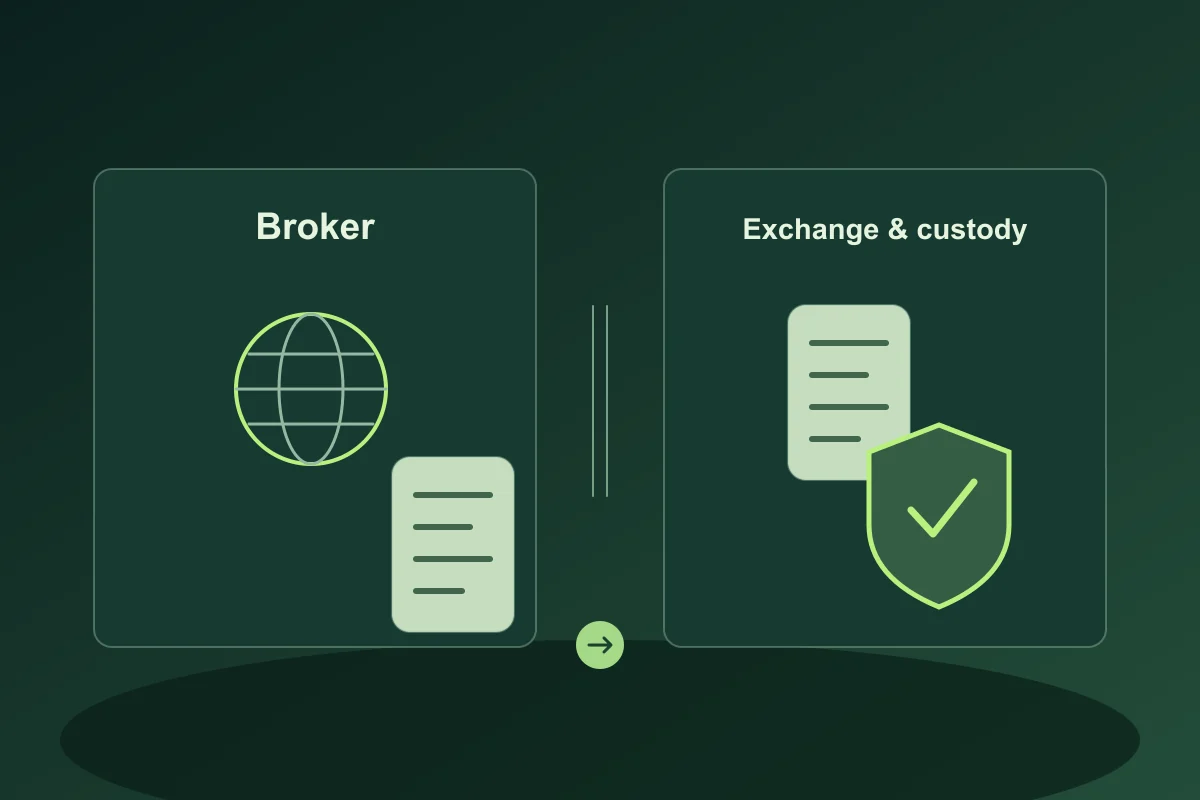
Start with acting for a customer
In financial usage, a broker receives and handles instructions to buy or sell for customers. In US securities terminology, the SEC distinguishes a broker acting for others from a dealer acting for its own account. A firm can perform both roles in different transactions. Identify its role in the particular activity rather than deriving it from the label broker alone.
Everyday usage can mean the account firm or an individual working there. Neither automatically supplies investment advice, portfolio management or authority to decide on your behalf. Each service has its own agreement and scope. First establish who receives the instruction and who is authorised to perform the requested activity.
Between an instruction and a completed trade
An instruction specifies an asset, side, quantity and price conditions. The broker handles it under the account's terms and execution arrangements. Submission does not confirm that the full quantity traded. Rejection, waiting and multiple fills are possible. Confirmations and account records should subsequently explain what was bought or sold and on what terms.
For illustration only, a buy limit for ten shares at USD 50 does not permit paying more than USD 50 per share. If all ten fill at 50 and an assumed USD 2 commission applies, the outlay is USD 502. This is not a real broker's fee. If only four shares fill, submitting an instruction for ten does not create a ten-share holding.
Check what remains of the original instruction. If four of those ten shares filled and six remain pending, a new instruction for ten does not merely complete the six. It can create another request alongside the existing remainder. This distinguishes the customer's intention from the recorded account state. Before correcting anything, locate the instruction number and confirmed status. A question about the record can be asked without submitting another transaction to resolve uncertainty. The distinction also matters when support helps with entry: preserve what was requested and accepted rather than treating the conversation alone as execution confirmation. Find the matching asset, quantity, price and charges in the records. This makes intermediation concrete: an instruction, its handling and an outcome that can be inspected. An account label or total balance cannot replace that chain.
Broker, dealer, exchange and trading software
These roles can appear in the same journey. One company may perform several, but access through one app does not establish that every organisation involved is the same.
Scroll the table horizontally to read every column.
| Term | Identify the function | Useful question |
|---|---|---|
| Securities broker | Handling customer transactions | Who accepts instructions and arranges execution? |
| Dealer or contractual counterparty | Trading with the customer | Against which company does the obligation exist? |
| Exchange | A venue matching trading interests under its rules | On which market is the instrument traded? |
| Trading software | Interface for information and instructions | Which firm and account does it connect to? |
Familiar software does not confirm the account operator's authorisation. Intermediation also does not eliminate conflicts or costs. The platform-selection guide begins with the product before comparing interfaces.
A share purchase is different from a price contract
A broker may provide access to an actual security. Another service described as a broker may offer a CFD, settling price differences without ownership of the underlying asset. A stock name in a search field cannot distinguish those products. Identify the instrument in the order ticket and agreement.
Similarly, US retail off-exchange forex involves a dealer framework different from a securities account. A crypto exchange may combine trading and custody under another structure. Do not transfer the protection, authorisation or execution rules of one product to all the others. The stocks versus CFDs guide develops the differences in ownership and obligations.
Who holds money and securities?
Receiving instructions and holding customer assets do not always happen at the same company. Some brokerage arrangements involve an introducing firm and a carrying or clearing firm that may hold assets and provide statements. Other firms perform several functions themselves. Read the agreement and statement details to identify the actual division.
Ask where the holding is recorded, who issues confirmations and who processes transfers of cash or securities. If two names appear, request an explanation of their relationship rather than removing one from your worksheet. The custody definition explains why the asset holder matters separately from the application or support desk.
How a brokerage service can charge
A transaction commission is only one possibility. Depending on the service, costs may include spreads or markups, conversion, market data, account fees, financing and transfers. A zero-commission headline concerns its specified conditions; it does not establish that every account activity is free.
Describe a complete scenario: amount, instrument, transaction count, account currency and any transfer out. Check each component's unit and minimum. A per-share price differs from an order minimum, and both differ from an annual account charge. Comparing two arrangements requires the same activity list for each.
Do not add charges that do not apply, but do not replace an unknown with zero either. Request a tariff and explanation in the appropriate currency. The total-cost guide helps assemble components without counting an expense twice when it is already embedded in price.
The firm, individual and permission need separate checks
Find the legal name in the agreement rather than relying on the brand. Then use the appropriate product and jurisdictional record: for example, BrokerCheck for US securities brokerage or NFA BASIC for the relevant derivatives and forex framework. In Israel, identify the permission or licence relevant to the proposed activity. One entry does not establish all of these things together.
Even when a number matches, compare contact details to reduce impersonation risk. Another group company's licence does not automatically cover your account. The legal-entity definition helps identify the contracting party without inferring residence from language. Checking authorisation does not promise returns, suitability or compensation for every loss.
Questions before using a service
Try completing this explanation: I give an instruction to a particular firm to buy a specified instrument, with assets held under identified terms. If a part is missing, request the document addressing it. A focused question is more useful than asking for the universally best broker.
Also establish how to correct a mistake, find a confirmation and transfer assets when leaving. A cheap account can be inconvenient for your needs, but that conclusion requires reading the conditions. Defining broker clarifies who does what. Deciding whether to use one requires further consideration of the product, costs and personal circumstances.
Common questions about brokers
Is a broker the exchange?
No. A broker handles customer instructions, while an exchange is a trading venue with its own rules. Several firms can participate in a journey, and not every instrument displayed in an account trades on an exchange.
Does every broker hold customer money itself?
Not necessarily. Execution, clearing and custody depend on the arrangement. Read names and responsibilities in agreements and statements rather than inferring them from the login screen.
Does a broker choose my investments?
Not simply because it is called a broker. Order execution, recommendations and portfolio management are different services. Check the agreed scope and authority without assuming that opening an account authorises all of them.
Does zero commission mean no costs?
No. Read the offer's scope and other components relevant to your scenario, such as conversion, spread, financing or transfer costs. There is no universal price for a service called brokerage.
This information is for learning and comparison, not investment advice. Verify product details and eligibility conditions against the current source.
About our methodology