
Guide
Forex demo versus live accounts: what practice can establish
A forex demo lets you practise with a simulated balance, without promising the fills, costs or decisions of a live account. Build a useful exercise, preserve its records and distinguish an ordinary broker demo from a paid evaluation programme.
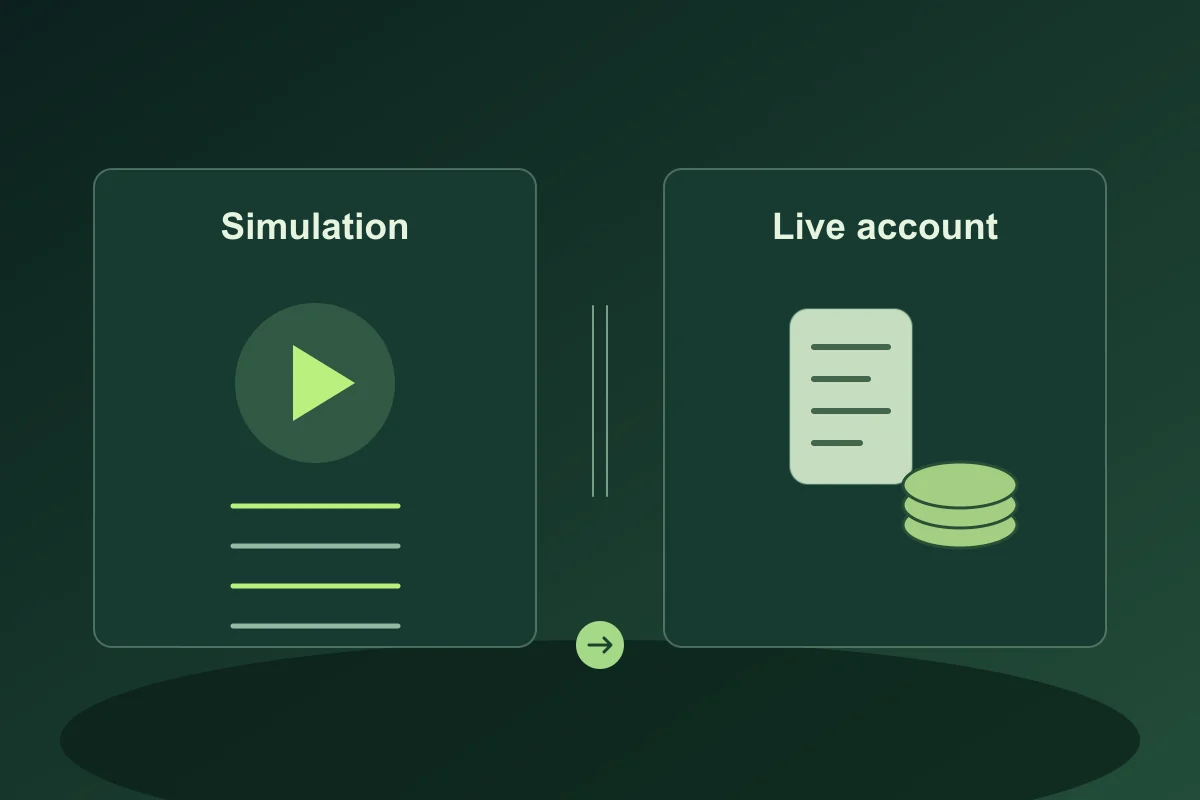
How a forex demo works
A demo uses virtual money to submit instructions and calculate outcomes in a simulated environment. It can teach where quantity fields are located, how an instruction changes exposure and what appears in the history. An increasing balance is not withdrawable profit, even when quotations update in real time.
A live account involves actual money and obligations under the company's agreement. That does not mean every transaction is sent to an exchange. OTC forex and CFD arrangements can make the firm the contractual counterparty. Live here means real financial exposure, rather than a promise of one particular external execution route.
Give the demo a narrow, testable purpose, such as understanding partial closure or reading the ask. Do not ask it to establish something it cannot, such as a company's ability to honour withdrawals or future investment returns. The first task is explaining what you did and why the displayed result followed.
Similar controls do not establish identical conditions
Software may show similar charts and fields in demo and live accounts. That similarity helps learning, but does not establish matching trading conditions. Symbol, account type and server identify the experiment; they are more than incidental login details.
Scroll the table horizontally to read every column.
| Topic | What a demo can help examine | What it cannot establish |
|---|---|---|
| Submitting an instruction | Direction, quantity and required fields | Identical live fill price or timing |
| Account history | Presentation of fills and changes | Completeness of every future export |
| Displayed charges | Costs included in the simulation | Every charge applying to live trading |
| Partial closure | Quantity changes in the chosen configuration | Matching behaviour in another account |
| Funding and withdrawals | Reading the described process | Actual transfer and bank approval |
Define success for each task. Finding the executed price is a completed learning exercise even if the simulated trade loses money. Profit colour is not a grade for understanding the interface.
Why demo and live fills can differ
A simulation does not have to reproduce every liquidity constraint, queue or delay of live trading. Official service documentation describes demo fills at displayed prices while live execution can involve several price levels or partial fills. This does not establish that every demo is perfect or every live account executes less favourably.
Consider a hypothetical EUR 2,000 purchase filled at 1.1000 in the demo and an assumed 1.1003 in a live scenario. A USD 0.0003 difference per euro amounts to USD 0.60 for that quantity. This is not a measurement of a company. It isolates entry only; closing prices and commissions can add differences.
Investigating a real discrepancy requires matching instructions, timestamps, quotations and fills, rather than two charts alone. One comparison cannot establish a fixed monthly slippage rate. Use a difference to formulate a question, not to invent a promise about future execution.
Match the balance and quantity convention
A large virtual balance can hide errors that would constrain a smaller account. In a hypothetical USD 20,000 exposure with an assumed USD 1,000 margin requirement, a USD 2,000 account leaves USD 1,000 before other effects. A USD 100,000 demo shows very different room despite an identical trade.
Likewise, an assumed USD 200 loss equals 10% of USD 2,000 but 0.2% of USD 100,000. These inputs illustrate scale, not recommended deposits or risk budgets. No live deposit is necessary to understand the distinction.
Where possible, choose a virtual balance, account currency and contract size appropriate to the question being studied. Record volume steps and position-accounting type too. The position-size and margin guide explains why quantity, planned loss and required collateral are separate calculations.
Find the costs missing from the simulation
Displayed demo expenses can differ between configurations. Check whether the calculation includes spread, commission, holding finance and conversion into the account currency. No fee line in a simulated record is not evidence that the corresponding live activity is free.
Use two columns: observed in the demo, and still requiring the live account's terms. For an observed spread, record time and symbol. If all practice trades closed in one session, do not describe the exercise as a test of overnight financing. The boundary of the conclusion should be clear without attaching a generic warning to every line.
Keep any additional cost scenario separate from the result actually displayed. The complete-cost guide helps identify components. A manual estimate assists investigation; it does not retrospectively change a demo fill or determine the bill in another account.
Practise an entire instruction cycle
Choose one task: entering a pending instruction, changing quantity, cancelling or closing partially. Before acting, write the expected effect on open quantity and exit instructions. Afterwards, inspect the record and anything still pending. A small misunderstanding here can matter more than a profitable outcome in the exercise.
Record acceptance, activation and fills separately. A stop-limit can activate without filling. A sale can close exposure in one accounting system while creating a separate position in another. Netting or hedging settings belong in the description of the environment.
Expand gradually, but do not change quantity, symbol and instruction type simultaneously while investigating a problem. A controlled comparison leaves one clear variable. The platform-selection guide provides a way to translate these needs into questions about a service.
Demo, historical testing and paid evaluations
A demo provides simulated practice. Historical testing uses past data and execution assumptions, manually or automatically. A paid evaluation adds a service agreement, progression rules and possibly reward conditions. All three can involve simulation while creating different expenses and obligations.
Evaluation fees are real money even when the trading balance is virtual. The account size in a programme name is not your deposit or automatically withdrawable money. A stage described as funded may remain simulated with conditional contractual rewards. Read the actual programme rather than deriving its structure from a marketing label.
For example, FTMO describes simulated-trading and educational services, not accepting brokerage deposits within that service. This does not establish the structure of every firm or future product. The evaluation-rules guide separates service price, loss allowance and stage conditions.
Demo profits are not a universal graduation threshold
A demo can help examine whether a rule was followed consistently. No trade count or profit percentage guarantees readiness for live trading. Different execution, costs and decisions with money at risk can change outcomes. Virtual practice also cannot fully measure your response to an actual financial loss.
Set operational criteria: explain quantity, locate a confirmation, identify a remaining instruction and calculate a loss scenario. These are directly inspectable. Do not select only successful trades to declare a method proven; preserve examples where the plan was not followed too.
Separate operational mistakes from trading decisions. Correcting an incorrectly entered quantity does not establish that the economic idea is sound. A properly executed losing scenario does not itself indicate a software fault. This distinction makes each exercise capable of teaching something specific.
Preserve an ordinary case and one with an unexpected outcome. For each, write the expectation beforehand, then retain instruction status and quantity changes. Check whether you could explain the difference to someone who did not watch the screen. If the explanation relies on memory alone, add the missing record to your process. More trades are unnecessary merely to obtain an answer; revisiting one record can teach more than another session. Date any configuration change so that two different environments are not compared accidentally. This is a suggested personal workflow, not a protocol certifying trading ability. It identifies what was learned and which information remains missing, rather than producing a success certificate from a period selected afterwards for favourable results.
Questions a demo leaves unanswered
A live account requires checks of company, residence, product, permissions and money-handling terms. Demo availability does not approve a live account in the same country. Registration details and server should match the agreement; installing software does not supply a licence or client-money protection.
Before deciding, list what was learned and what remains open: live execution, tariffs, documents, restrictions and withdrawals. A demo button does not settle the corresponding question. Written explanations can be requested without making a test deposit.
Preserve important practice history outside the account. Demo accounts can expire or change under operator policies. A short archive of settings, instructions and conclusions lets learning continue after a reset. Deciding to keep practising is itself a useful outcome, rather than a failure to move to live trading.
Common questions about forex demos
Can demo profits be withdrawn?
An ordinary demo balance is not money you own for withdrawal. Contractual rewards in an evaluation programme are a separate arrangement, rather than converting a regular demo balance into cash.
Do live quotations guarantee live execution?
No. An updated price feed and a fill simulation are different layers. The same movement on-screen does not reproduce liquidity, queues, delays or instruction handling.
How long should someone remain on a demo?
There is no universal period guaranteeing success. Define capabilities and unresolved questions, then examine records and outcomes rather than counting days alone.
Is a paid evaluation just a free demo?
No. Simulated trading can still involve a service price, breach rules and reward conditions. Compare the actual agreement and cash expense, rather than the displayed balance alone.