Editorial comparison
HFM Premium vs Zero: when tighter spreads justify commission
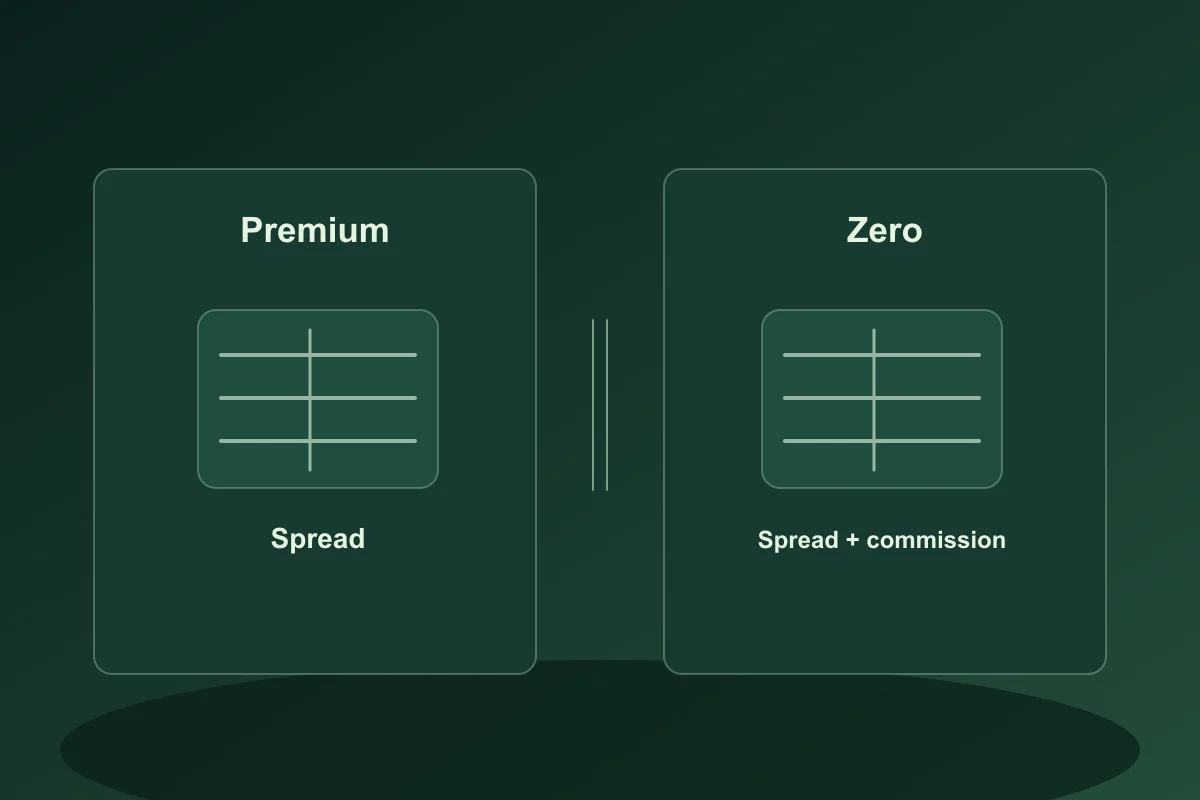
Premium and Zero price HFM trading differently. For the relevant forex products, Premium generally builds its trading charge into the spread, while Zero combines a spread with a separate commission. A useful choice compares the same pair, position size and trading hours, then adds holding costs, account-currency effects and the terms of the actual contracting entity.
Define the accounts before comparing them
This comparison concerns the forex configurations on HFM's international website. Calculations use a USD account and a standard lot of 100,000 base-currency units. They are not quotations for every HFM customer. The website identifies several group companies, including HF Markets (SV) Ltd and HF Markets (Seychelles) Ltd; the brand does not establish which company will contract with an applicant or which protections apply.
Premium is an account name, not automatic professional-client classification. Zero does not mean zero total cost. These are leveraged trading arrangements, and a CFD does not give ownership of its underlying asset. The HFM review explains the wider service. Here the narrower task is deciding how two account charging structures affect the trades in a journal.
What the account tables actually distinguish
Scroll the table horizontally to read every column.
| Component | Premium | Zero |
|---|---|---|
| Advertised spread floor | From 1.4 pips | From zero on applicable forex symbols |
| Separate forex commission | None for the relevant products; exceptions apply | Published USD table: $6 per 100,000-unit round trip |
| Listed account currencies | USD and EUR | USD and EUR |
| Swap-free treatment | Specified instruments and conditions | Specified instruments and conditions |
A spread floor is not an average execution cost. Zero's spread can widen when liquidity changes, and Premium's commission statement has product exceptions. Neither forex treatment should be extended automatically to share CFDs or gold. Compare the symbol specification and the rate applicable to the selected account, rather than treating a promotional headline as a complete contract.
Read the commission units first
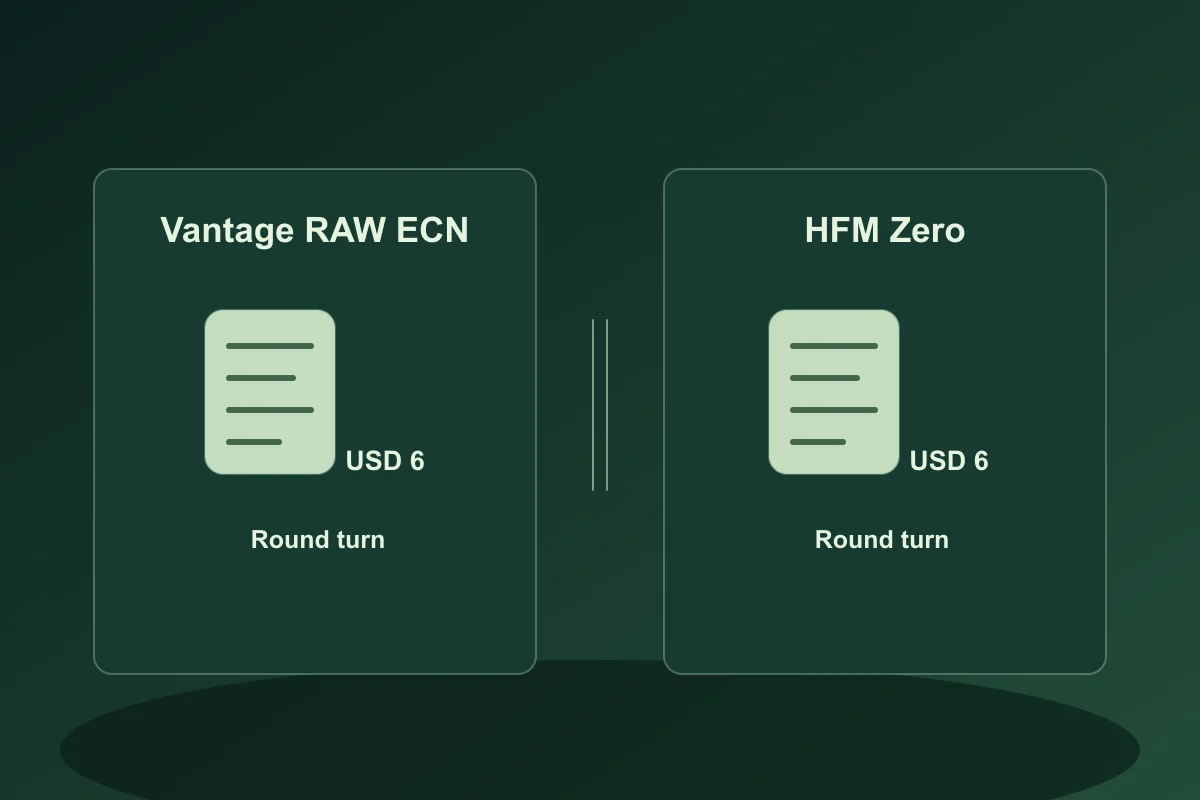
Zero's forex table shows $0.06 round turn for 1,000 units and $6 round turn for 100,000 units. Round turn covers opening and closing together: adding another $6 at the exit would double-count it. The gold table uses different units and a different charge. A forex lot and a gold lot are not interchangeable quantities.
Account currency also matters. HFM describes transaction-time currency conversion for MT5 and fixed account-currency amounts for MT4. Dividing a round-turn amount in half can help economic modelling, but does not establish when the platform books each debit. Inspect the actual statement format, especially if commission appears at entry. The quoted USD equivalent and the account-currency posting can differ without either being a separate additional fee.
A hypothetical trade and the break-even spread
Assume one standard lot of EUR/USD in a USD account, where a pip is $10. For illustration, Premium's spread is 1.6 pips and Zero's is 0.3 pips. Assume no midpoint movement, stable spreads and no overnight holding.
Scroll the table horizontally to read every column.
| Estimated round-trip component | Premium | Zero |
|---|---|---|
| Spread cost | 1.6 × $10 = $16 | 0.3 × $10 = $3 |
| Separate commission | $0 for this forex example | $6 |
| Combined components | $16 | $9 |
Zero is $7 cheaper under those assumptions. With an unchanged midpoint and spread, crossing the market on entry and exit represents one full spread, not two full spreads. If entry and exit spreads differ, use the actual transaction prices rather than mechanically reusing the opening quote.
The $6 round-turn commission equals 0.6 pip at this size. Zero wins on these two components only when its spread advantage exceeds 0.6 pip. At 0.2 lot, assuming proportional charging, the monetary figures scale down by five; increasing position size does not create a new relative advantage. The Raw-account break-even guide develops the same calculation.
Holding a position changes the question
A few dollars saved on an intraday trade may be outweighed by charges during a longer holding period. Both account pages qualify swap-free treatment by instrument and additional terms. That does not establish an exemption for every asset, holding period or customer account.
Record the complete symbol, trade direction, charging day and intended duration before comparing an overnight position. Establish whether that instrument qualifies and whether another charge can apply. An unread or unspecified charge remains an unresolved cost, rather than zero. Two charts can look identical while the account's holding-cost treatment differs enough to change the choice.
Use a journal rather than the smallest advertised spread
Select representative trades from your actual routine: perhaps the European session, the US open and an overnight position. Record size, entry and exit spreads, commission, financing and any difference between requested and executed prices. Comparing one account's minimum advertisement with the other's observed average is not a fair experiment.
A spreadsheet can reprice the same sizes under both charging structures. Label the result a counterfactual estimate: it does not prove the trade would have filled identically in another account. A demo can help you understand symbol units and statement entries, but cannot establish future live execution quality. Keep the origin of each input visible in your own worksheet: account specification, actual fill or hypothetical assumption.
Which charging structure deserves closer attention?
Premium is worth examining when a spread-based forex charge is operationally convenient and the spreads on your relevant trades are acceptable. Zero deserves attention when a measured spread advantage exceeds the additional commission. High trading frequency alone does not settle the question; many trades can still occur when the gap is too small.
Premium's advertised zero opening minimum is not a recommended trading budget or a cap on losses. Margin headroom, changing prices and charges still require capital. Using more leverage to fit a small balance can rapidly increase risk. Choosing a different charging structure does not repair an unprofitable method or turn a forecast into a reliable outcome.
Checks before changing accounts
Confirm that the alternative is available under your entity and platform, that both calculations use the same account currency, and that difficult trading periods are included. Retain the relevant statements and specifications so you can identify a subsequent tariff or symbol change. Moving to another account type may involve a separate account; do not assume that history, settings or permissions migrate automatically.
After completing the internal account comparison, continue to Vantage vs HFM for a cross-company decision, or HFM vs Eightcap when platform workflow matters. The useful conclusion comes from the full arrangement and the specific agreement, rather than the account label.