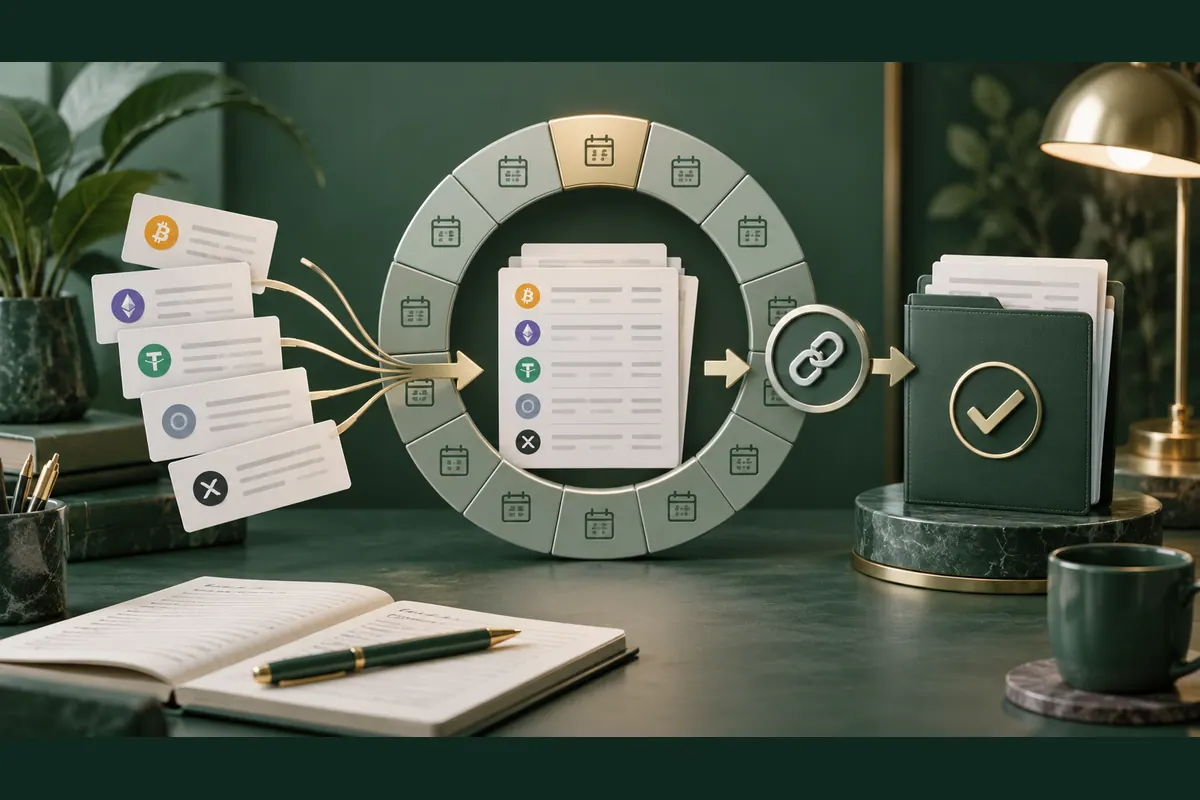
Editorial comparison
Koinly vs Bybit, Bitget and Coinbase exports: consolidation and record checks
An exchange file records activity at that provider; Koinly can combine sources and calculate from the data. Check coverage, transfers and duplicates before handing over reports.

Koinly and exchange exports: consolidation does not replace the source
A file from Bybit, Bitget or Coinbase records activity at that provider. Koinly can combine sources, match transfers and calculate from imported history. It does not automatically repair every gap, and one exchange file does not necessarily include an acquisition elsewhere. The choice concerns organization and review rather than “trusted source” versus “always accurate report.”
For activity confined to one account without external movements, organized file-based work may be a reasonable process. For assets moving across exchanges and wallets, consolidation can help connect outgoing movements, receipts and earlier acquisitions. Both approaches require identifying included data types and reconciling balances.
Keep original files even when using consolidation software. They allow a discrepancy to be traced back to a row, while software may change classification or combine several records. Neither needs to be presented as an absolute replacement for the other.
The Koinly review explains its service role. Here the focus is the process from three data sources to a checkable output. No actual import or report generation was performed, and no report is promised to fit a particular country's law or filing form.
File types at Bybit, Bitget and Coinbase
Balance snapshots, order histories and asset flows answer different questions. A balance describes holdings at a point in time; fills explain execution and price; movements explain deposits, withdrawals and charges. Choose the output by its purpose before download, rather than relying on the generic label Statement.
Scroll the table horizontally to read every column.
| Provider | Documented files | Scope check |
|---|---|---|
 Bybit Bybit | PDF account snapshot, CSV transaction log and CSV order history | Account/product; export guide excludes P2P orders |
 Bitget Bitget | Movements, orders, balances and ownership details in type-specific formats | Website, account type and per-request date window |
| Coinbase | Monthly/custom HTML, PDF or CSV statements | Asset, movement type and region-specific tax reports |
The examined Bybit and Bitget guides describe website exports rather than equivalent app actions. Coinbase describes mobile access to statements too. These operational differences do not measure completeness; a convenient download still needs content review.
The Bybit, Bitget and Coinbase pages place reports within each service. One provider's client record does not establish inclusion of history elsewhere, and an ownership report does not replace fills or acquisition prices.
Source files and period boundaries: preparation before Koinly import
For each file, record provider, account, data type, period boundaries and download date. An apparently complete file can cover only movements or one product. Selecting “all assets” does not necessarily select all subaccounts. A short file inventory prevents overlapping and missing downloads.
Bitget describes a two-year selected-date limit per transaction/order-history request. Longer coverage requires several requests. This does not establish that only two years are retained, nor guarantee availability of every older row merely because the period was split. Check actual output.
Keep an unchanged source copy. A separate working file allows annotations and investigation without damaging import compatibility. Column names, date formatting or decimal separators can change interpretation. If adjustment is needed, record what changed and why rather than presenting the amended copy as the original.
Koinly documents individual file uploads and a 10 MB limit. Larger files can be prepared in suitable parts with consistent headers, checking that boundary rows are neither omitted nor duplicated. Preserve all original period coverage after uploading.
Koinly API limits: Bybit, Bitget and Coinbase differ
Koinly lists connector-specific limitations, so “API supported” does not establish complete history. Its bybit.com connection lists unavailable API activity including bot trades, copy trading, Launchpool rewards and NFTs, alongside possible conversion and account-transfer gaps. These claims concern that documented connector and are not automatically applied to Bybit EU.
For Bitget, Koinly states that the API supplies the latest two years and omits certain Risk Capital movements. That published connector limit differs from a per-request export window on the website. Similar numbers describe different things and should not be collapsed into one historical-availability conclusion.
For Coinbase, Koinly lists futures and automatically compounded DeFi Lending rewards as not imported. Legacy Coinbase Pro history needs separate records. The described flow starts through Coinbase; do not invent manual-key steps from a generic paragraph inconsistent with that route.
Check integration instructions before syncing and results afterwards. When activity is missing, obtain suitable source records and supplement according to instructions; expanding trade or withdrawal scope does not solve a data gap. Data-consolidation authorization remains read-only.
Duplicates and transfers: one economic event, several rows
The same fill can appear in order history, asset movements and API data. Rows need not be identical: one contains execution notional, another a balance change or separate fee. Koinly warns that duplicate detection may fail across formats or API/CSV overlap. Uploading everything without a plan can count one event more than once.
Decide which source represents each activity type and period. When a file supplements an API gap, inspect overlap rather than assuming it disappears. Record the supplement and information it should add. Adding a full year to fix one omission can also add already-imported events.
A transfer between owned accounts creates two sides. Match the outgoing and incoming records and any fee rather than treating both as purchases. Internal transfers between main and subaccounts also need records explaining location changes without doubling total holdings.
Before deletion, inspect identifier, time, asset, quantity and fee currency. Similar prices do not prove duplicates; separate fills can be nearly identical. The goal is preserving actual events and avoiding double counting, not reducing transaction counts to fit a chosen plan.
Balance reconciliation: check each asset, not only portfolio value
Balance review starts with each asset's quantity at a common point in time. Currency value changes with market and display-currency prices, making it a secondary check rather than a substitute for quantity. A similar aggregate value can hide a missing purchase or fee recorded in the wrong asset.
Assume a hypothetical ledger: opening 1,000 USDT, spending 600 USDT on another asset, an invented 1 USDT fee, receiving 2 USDT funding and paying 100 USDT externally. Closing balance is 301 USDT. An additional 200 USDT transfer between owned accounts changes allocation without changing the consolidated total.
The example is neither a customer balance nor a fee schedule. It shows how separating outside movement from internal transfers makes the equation checkable. The purchased asset needs its own quantity review; reconciling USDT does not approve that asset's balance or acquisition values.
Investigate differences by movement type: acquisition, sale, payment, charge, reward or transfer. A snapshot can identify when a discrepancy appeared without explaining it alone. Correct the right event with evidence rather than adding an arbitrary balancing entry merely to make the screen look consistent.
Acquisition history: why a Coinbase or other exchange report can be incomplete
An asset arriving at an exchange can come from another wallet or provider. Its deposit row explains quantity received but not necessarily the original purchase price. A summary from the receiving exchange is therefore incomplete if relevant history predates the deposit. Koinly describes using complete history for acquisition calculations and checking missing purchases.
For illustration only, suppose 0.5 ETH was bought for USD 500 at one exchange, moved to a wallet and later sold elsewhere for USD 650. The cash difference before charges is USD 150. That is not a taxable-gain determination; method, expenses and professional conditions can affect reporting. It simply shows why a deposit amount is not an acquisition price.
Complete the purchase receipt and transfer sequence before relying on a calculation. Changed custody is no reason to reset acquisition value or select a new market price arbitrarily. If evidence is missing, retain the question for investigation rather than presenting nonexistent precision.
A selected report year does not eliminate earlier history needs. A single-year file can summarize events occurring then while calculations depend on previous years. Separating report period from source-history period is a central benefit of an organized inventory.
Manual review versus Koinly: when consolidation adds value
Manual work can fit a small number of sources, understandable activity and someone responsible for reconciliation. Its advantage is direct access to source rows and an explanation for every change. Complexity increases with exchanges, wallets, transfers and fee currencies, requiring consistent rules rather than memory.
Koinly can consolidate sources, display movements and calculate from records. That is particularly useful for transfer links and tracking acquisitions over time. The operational drawback is that a finished-looking result can conceal coverage gaps unless connector limitations and warnings are inspected.
There is no need to choose total automation or spreadsheets alone. Preserve originals, sync supported information and document supplements. Each manual addition needs a source and defined purpose. Manual is not inherently better; automatic is not inherently more complete.
The selection criterion is explainability: sources used, included activity types and remaining questions. If software does not recognize a complex event, do not assign an arbitrary label merely to proceed. Consolidation adds value when it reduces difficulty without erasing the review trail.
Koinly report cost and language: select output after data review
Koinly report access is purchased for the needed tax year as a one-time payment subject to capacity conditions. It is not an automatically renewing next-year subscription and does not include filing on the user's behalf. Review import quality and the required output before purchase rather than assuming payment solves missing data.
Distinguish a summary from detailed professional working files. CSV outputs support row-level inspection, while PDF can present a summary. Selection should fit the professional's requirements and actual activity. The Koinly plans review expands on report years and purchasing.
Hebrew is absent from Koinly's published report-language list. Coinbase reports specific to the United States or Canada also do not become Israeli documents because they are available in an account. Interface language is not residence, and file format is not tax-authority approval.
Retain generation settings beside date and data version. Later historical supplements may require a new output, subject to plan conditions. The first downloaded file is not final simply because it was exported. Professional preparation and filing remain separate from operating calculation software.
Professional handover: the Koinly package and its underlying sources
A checkable package contains reports, source files and a source map. Include periods, accounts and activity types, plus explanations of corrections and outstanding gaps. Signing capability or API secrets are unnecessary to explain records. Financial material should be shared with the professional preparing the filing through an appropriate channel.
Before handover, confirm quantity reconciliation, meaningful transfer links and absence of duplicate sources. Check that older acquisition history was not cut from the package. Separate facts, assumptions and classifications requiring professional review; a software label is not a binding professional determination.
Readers holding wallet assets can continue to the Ledger and Koinly workflow, addressing public addresses and transfer continuity. It complements exports rather than proving uniform support for every application or chain.
Koinly adds value when consolidated history makes activity easier to see and explain. Exchange files supply the underlying trail. A review-ready result combines both as needed without promising automatic accuracy, reduced tax or acceptance of a particular report.