
Editorial comparison
Merrill Edge vs Fidelity: self-directed accounts, purchases and exit costs
Merrill Edge Self-Directed and a US retail Fidelity brokerage account offer similar base pricing for ordinary online stock trades, but the surrounding workflow differs. Linked-bank funding, dollar-based purchases, charges for other products and the cost of moving a portfolio can matter more than a headline stock commission.
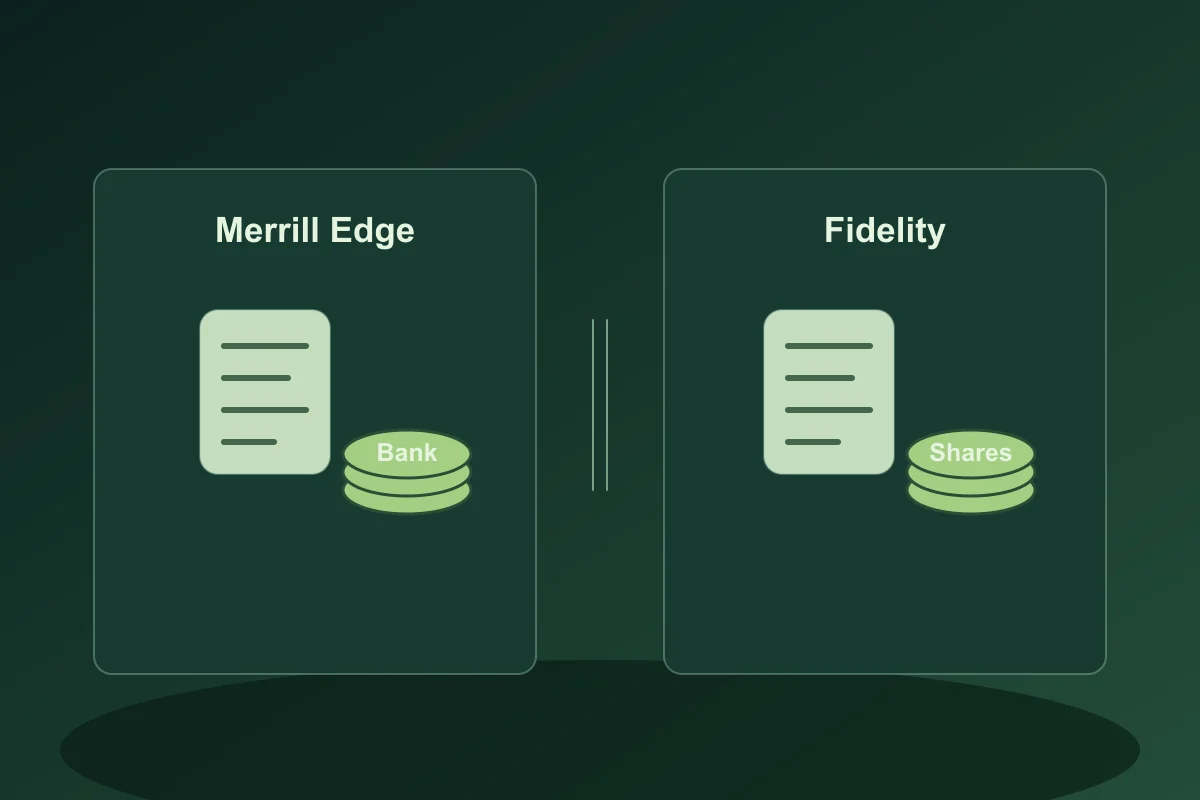
Merrill Lynch is not a single pricing arrangement
A Merrill Lynch versus Fidelity search should begin by identifying the Merrill service. This comparison selects Merrill Edge Self-Directed, excluding full-service wealth management and Merrill Guided Investing. Managed arrangements can provide different services and impose different charges. The self-directed trading schedule should not automatically be applied to them.
The Fidelity side is a US retail brokerage account, not another business using the Fidelity name. US Fidelity's policy does not open accounts for new customers residing outside the United States; existing customers moving abroad face separate restrictions. This article also does not establish new Merrill eligibility for a particular resident. Hebrew and English are publication languages rather than proof that an account can be opened from a particular country.
What zero commission means in the ordinary case
Scroll the table horizontally to read every column.
| Component | Merrill Edge Self-Directed | US Fidelity |
|---|---|---|
| Applicable online US stock trades | Zero base commission | Zero base commission |
| Online options | Zero base plus $0.65 per contract and applicable charges | Zero base; separate contract charges and conditions |
| Funds, foreign securities and representative assistance | Separate schedule and exceptions | Separate schedule and exceptions |
| Margin borrowing | Separate interest charge | Separate interest charge |
Zero execution commission does not remove bid-ask spreads, fund expenses, taxes or applicable transaction charges. Pricing for one product does not establish another's treatment: a US stock, mutual fund and foreign security can have different charges. Compare the selected product and trade confirmation rather than only the opening statement on a pricing page.
Dollar-based purchases and linked-bank convenience
Fidelity documents dollar-based purchases of eligible US stocks and ETFs from $1. Fractional orders can be day market or limit orders and execute during regular trading hours, with applicable rounding rules. This can be useful for a fixed purchase budget without recalculating whole-share quantities each time.
For Merrill, the starting requirement may instead be integration with an existing Bank of America account. Avoid assuming that every capability is present or absent on the other side. If fractional purchases are essential, confirm the particular security and proposed account explicitly. Dividend reinvestment is different from entering a new dollar-based buy order; the two should not be collapsed into an unsupported yes/no feature comparison.
What the Bank of America connection changes
Merrill describes linking eligible banking and investing accounts, viewing them together and making transfers, including scheduled and recurring transfers. This is an operational benefit for someone already using the arrangement. It does not mean every account, ownership structure or transfer qualifies for immediate movement.
Deposited money is not necessarily immediately withdrawable, and buying power is different from cash available to withdraw. Check the deposit source, matching ownership and release conditions. At Fidelity, evaluate the funding route you actually intend to use rather than attributing the same banking relationship to it. Transfer convenience does not remove the distinction between a bank, a broker and the product holding idle money.
Include the cost of leaving
Merrill's general self-directed account schedule lists a $49.95 full outward account-transfer fee, while partial transfers are listed without that transfer fee. Fidelity's service table lists a zero transfer-of-assets fee. Account-specific services and receiving-firm charges still need checking; this does not make every withdrawal or exit free.
In a hypothetical portfolio worth $2,000, $49.95 is approximately 2.50% of value. Against $20,000 it is approximately 0.25%. This is a transfer charge rather than a market loss, and calculating it does not require selling. Fidelity fractional-share positions cannot be transferred externally in kind and must be liquidated before transfer out. Consider the sale price, tax consequences and transfer conditions separately. Selling should not be described as an economically neutral technical step.
Distinguish securities, cash and failure protection
A brokerage account can hold different products with different protection arrangements. Subject to its rules, SIPC addresses missing customer assets when a member broker fails. It does not cover a stock falling in value or an investment failing to meet the investor's objective. It also does not turn a money market fund into a bank deposit.
For idle money, identify the product rather than relying on a cash-balance label. Establish whether it is a bank deposit, fund or another balance, how it becomes withdrawable and which rules apply. A displayed yield can change and is not a substitute for product identification. Understanding market risk versus the handling of assets in a broker failure does not require selecting a security or assuming a future interest rate.
Test an ordinary monthly routine
Consider a hypothetical purchase budget of $200 per month. Useful questions include whether that amount can be entered for the required security, when funding is collected and whether cash remains uninvested. At Fidelity, check eligibility and fractional-order conditions. At Merrill, inspect the proposed order workflow and whether the banking connection genuinely simplifies the routine.
No return assumption is needed. Work through three months on paper: funding, order, dividend and record keeping. The stock order-types guide explains why market and limit orders do not promise the same result. The currency and custody cost comparison extends the calculation when funding starts in another currency.
What can reasonably decide the choice?
For someone with eligible Bank of America accounts, Merrill integration can justify examining its self-directed service. For someone needing systematic dollar-based purchases of eligible securities, Fidelity's documented capability justifies a focused comparison. In either case, establish account type, residence, asset and exit cost first.
Continue to Charles Schwab vs Fidelity or Interactive Brokers vs Fidelity for another arrangement. These comparisons do not approve a new account, provide personal advice or guarantee portfolio growth. Operational convenience still requires deliberate asset and risk choices, and a zero base commission is not the entire cost.