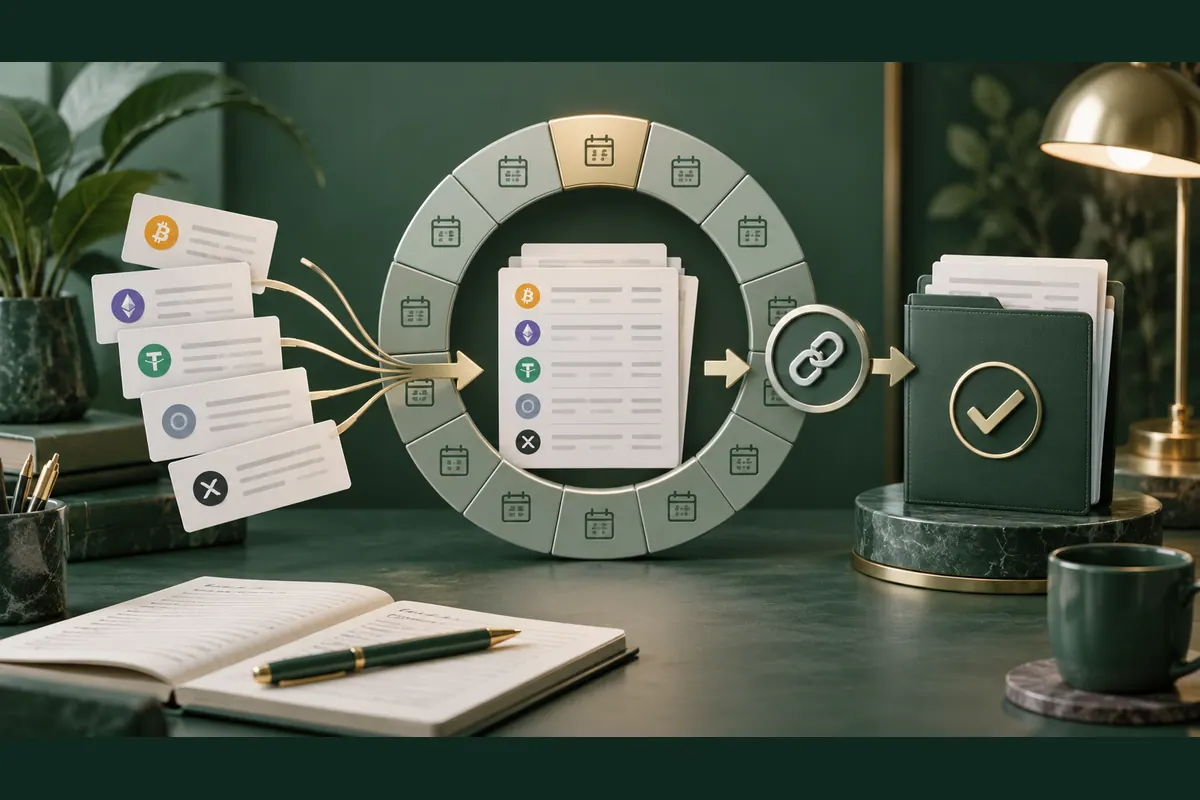
Editorial comparison
TraderSync vs Koinly: a trading journal or consolidated crypto records
TraderSync analyses decisions and trades; Koinly consolidates crypto history and reports by tax year. Compare execution grouping, transfers, acquisition history, exports and professional preparation.

TraderSync and Koinly: two questions about the same history
TraderSync and Koinly may read some of the same activity but organize it for different purposes. TraderSync is a trading journal for trades, notes and tags. Koinly consolidates crypto records, matches transfers and produces reports or files for professional preparation. Start by deciding whether you want to understand trading decisions, assemble reporting history, or do both.
Scroll the table horizontally to read every column.
| Question |  TraderSync TraderSync |  Koinly Koinly |
|---|---|---|
| Why a trade was taken | Notes, tags and analytical reports | Crypto records and activity categories |
| What happened across sources | Imports through supported connections | Supported exchanges, wallets and chains consolidated |
| What is produced afterward | Trade and execution exports | Reports and records for a tax year |
These services need not compete for an overall score. A journal can identify a process change; consolidated records can trace an asset transferred across locations. Even when both display profit and loss, grouping method, history coverage and the number's purpose require examination.
Someone checking adherence to personal rules can begin with a journal. Someone collecting distributed activity for an accountant should inspect every crypto source. The TraderSync review and Koinly review explain each service without portraying software as a trading provider or tax adviser.
Record scope: journaled trades versus broader crypto activity
TraderSync describes journaling support for several asset classes, including shares, futures, forex and crypto. This concerns records and analysis rather than permission to trade every product. Koinly focuses on crypto records from exchanges, wallets and chains. Consolidating one trading account does not necessarily consolidate all activity needing a historical record.
If you bought an asset on an exchange, moved it to a wallet and received further activity at that address, exchange trading history tells only part of the story. Professional preparation requires identifying other missing events. A listed exchange does not establish that every product, bot or transaction type imports through the same method.
The distinction matters for derivatives too. A contract result, balance movement and spot purchase are not necessarily the same source record. Keep product and account names beside exports so different activities are not combined merely because the same currency appears. Professional treatment is separate from file-import capability.
Map sources before selecting software: every exchange, account and public address used. Check import method and date coverage for each. This collects evidence rather than determines tax or promises universal synchronization. A complete list prevents an organized journal concealing history left outside it.
Transfers and holdings: why acquisition history still matters
When an asset moves between locations, preserve the relationship between outgoing and incoming records and the holding's origin. Koinly describes transfer matching and missing-history checks. The aim is consolidated inspectable records, rather than deciding treatment from an isolated row. Ownership, transaction type and original evidence require examination.
A useful check compares quantities and times at both ends, together with an identifier where available and associated expense. If quantities differ, investigate a fee, additional event or missing data. Do not delete records merely to make the balance look right. Automatic matching should remain explainable against sources.
A journal may group entries and exits to examine decisions. An asset remaining in a wallet at period end still belongs in the holdings map even without a closed trade to analyse. This explains why a closed-trade report and a balances report need not have the same total or row count.
Retain activity-origin and transfer evidence beside records. History becomes harder to reconstruct after an old source closes or restricts exports. Public-address documentation does not require private keys or recovery words. If acquisition origin is uncertain, preserve the question for investigation rather than invent a cost matching a preferred outcome.
Arithmetic example: a partial sale does not close the entire holding
For a hypothetical example only, suppose two identical crypto units are purchased at USD 100 each and one is later sold at USD 130. Purchase outlay is USD 200, sale proceeds are USD 130, and the sold unit's difference is USD 30 before expenses. One unit remains held. These figures are neither market observations nor a taxable-income or tax-rate calculation.
The example shows why the entire purchase outlay should not be subtracted from a partial sale's proceeds to describe that sold unit. It also shows why an open holding is not a closed trade. Purchases at different prices or periods require an appropriate calculation method checked with a professional; no method is recommended here.
In a journal, you may analyse the partial-sale decision and keep the remaining holding within one narrative. Consolidated records also need to trace its quantity and history onward. Both perspectives can help, but identify each report's unit: execution, grouped trade, asset or reporting period.
When screens disagree, inspect dates, expenses, valuation rates, grouping and source records before concluding. Different report scope can explain a discrepancy without an arithmetic error. Keep a short explanation sheet connecting each figure to a record, and take treatment or classification questions to a professional instead of assuming the higher or lower result is correct.
Importing into TraderSync and Koinly: reconcile before summarizing
TraderSync import method depends on the connector, distinguishing Autosync from CSV. Koinly supports connections, files and public addresses according to service and network. In either case, a support list starts the investigation; it does not prove complete history without gaps or duplicates.
Begin with one source and a short period. Compare a simple trade, transfer and closing balance against originals. When adding another source, preserve account name and imported range. Importing every year immediately can produce many rows without a clear origin for discrepancies.
Koinly warns that combining API and file imports in one wallet can duplicate records because source fields do not always match. Supplements should target missing periods or events. A different identifier does not necessarily mean a different event, and equal row counts do not prove full reconciliation.
Retain originals before changing categories and annotate every correction. For trading records, inspect partial fills and expenses; for crypto records, also inspect transfers and remaining holdings. Koinly versus exchange exports expands the consolidation check. The goal is explainable history rather than a tidy number produced by undocumented adjustments.
Reporting files: journal CSV versus Koinly reports
TraderSync documents CSV exports of trades and executions. They can support review or professional work, but format alone does not establish suitability for specific reporting requirements. Identify row contents, history completeness and information still needed outside the journal.
Koinly offers a complete PDF and itemized CSV files such as transactions, gains, income and holdings. These are different outputs, so agree with the professional on what to supply. A summary does not replace original records, and detailed output does not prove appropriate settings or classification for your circumstances.
Koinly's published report-language list includes English and other languages but does not list Hebrew. A Hebrew article does not change service or file language. An international report is also not proof of an approved Israeli form. Check local preparation with a professional using the actual material.
Koinly states that it does not file reports with authorities on the user's behalf. The process therefore needs professional review and filing responsibility where applicable. When retaining a revised version, identify changed data so contradictory files are not sent without explanation. Export is a workflow stage rather than confirmation that reporting is complete.
Sensitive records and permissions in journal and report connections
Activity records can be sensitive even without trading permission. They reveal assets, dates, usage patterns and sometimes relationships between wallets. Koinly describes read-only API and OAuth connections. That limits intended connection actions but does not make retrieved information public or unimportant.
Before connecting any service, examine both source and software instructions. Do not add trading or withdrawal permission to fix missing history. Missing information calls for checking import method, period or another source rather than expanding authority unnecessarily. Public-address imports do not require private keys or recovery words.
For file imports, consider fields unnecessary for the task. Keep secure originals and check whether support screenshots expose account details, balances or personal information. A suitable sample can explain a problem without sharing complete history. Privacy assessment belongs in software selection but does not replace completeness checks.
When discontinuing use, inspect subscription cancellation, connection removal and record retention separately. They are different actions. Exported files can retain information after disconnection, while an exchange-side permission requires handling at its source. A quiet screen does not establish a revoked connection or deleted records.
Recurring TraderSync billing and a Koinly tax-year purchase
Billing differs. TraderSync offers a subscription with periods and tier-dependent features; policy describes renewal until cancellation. Koinly states that report plans are one-time purchases for the needed tax year, without automatic next-year billing. A journal's monthly price and a tax-year report purchase are not equivalent subscriptions.
Koinly requires checking yearly transaction capacity and account-wide capacity. Older history can be necessary for calculations even when the requested report covers one year. Billable count is not always file row count because grouping and exclusions apply. Use the service's displayed count and requirements rather than guessing a plan from purchase count alone.
TraderSync's trial excludes trade and execution exports, so plan what can be evaluated before a suitable subscription is required. Refund and cancellation rules differ between services. Retain order summaries and applicable terms instead of relying on a broad promise from a short advertisement.
Users needing both tasks can budget separately: ongoing documentation during use and preparation material for the required reporting year. The Koinly plans guide expands counting and report checks. Fit the purchase to actual work rather than a low-looking number with its billing period omitted.
A combined workflow: preserve decisions and prepare complete history
When using both services, define an output for each. The journal should retrieve a trade and its explanation. Consolidated records should show sources, movements and holdings and produce inspectable professional material. Every number need not match across screens, but differences should be explainable by scope, period or calculation.
A simple process begins with retaining unmodified source statements. Import a sample, reconcile it and extend history gradually. Annotate each correction. At period end, inspect remaining holdings as well as closed positions. This distinguishes a trading question from a data question.
Professional preparation should receive detail, sources and open questions where needed, rather than only a PDF. Do not change categories merely to reduce a report result or portray automatic matching as authority approval. The goal is traceable material with clear responsibility for professional judgments and filing.
Examine TraderSync when the problem is analysing decisions and trades. Examine Koinly when the problem is consolidated crypto history and reports for a particular year. The choice need not be exclusive. Both remain work tools; using them does not guarantee trading outcomes, tax savings or acceptance of a filing.