Guide
How to buy bitcoin: payment, spot purchase, custody and exit
A practical BTC spot purchase: check payment access, calculate net quantity, place an order and choose custody. Includes network and address checks, delayed transfers, records and selling.
Define a BTC spot purchase
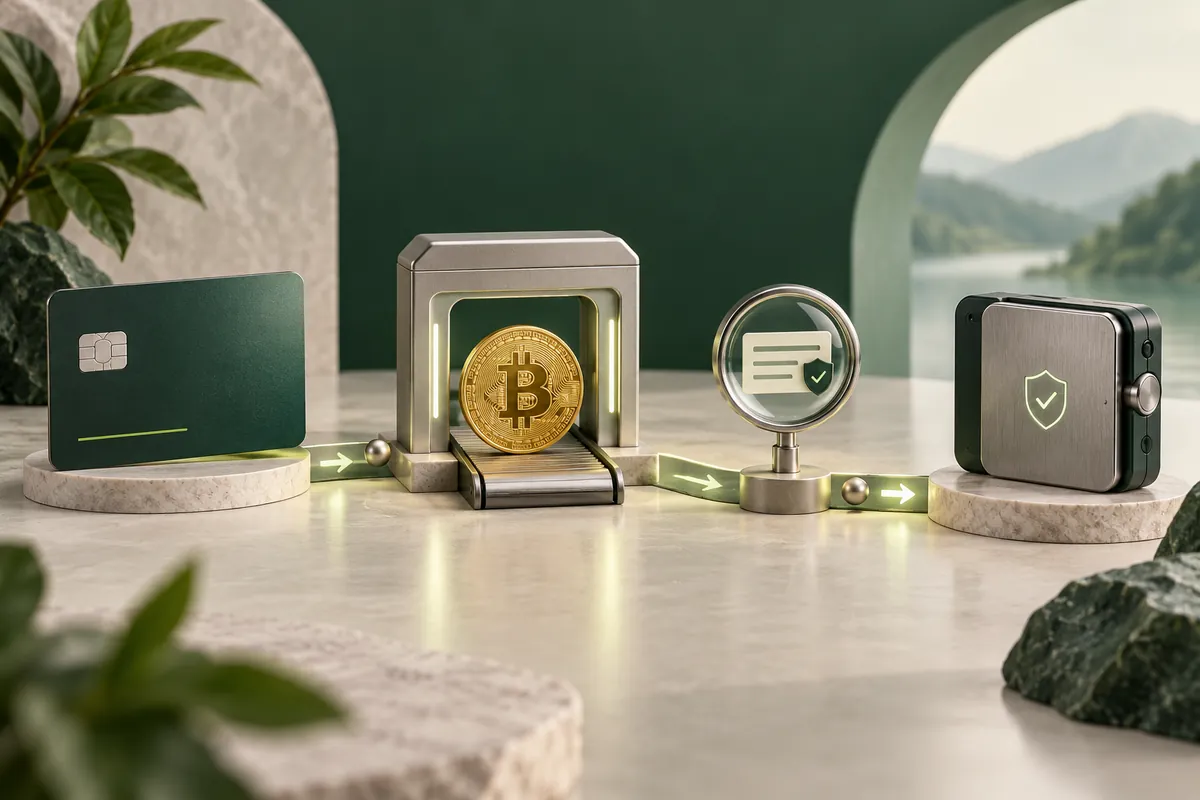
To buy bitcoin for holding, use a route that credits a BTC spot balance and allows withdrawal under its terms. Check that the product screen names BTC and a spot purchase. A perpetual or CFD tracking bitcoin has a different purpose and is outside this purchase process. You can buy part of a coin: one BTC divides into 100 million satoshis. Actual minimum purchase size depends on the provider and product.
The complete process covers payment, purchase, credited quantity, custody and an eventual sale. Bitcoin can fall sharply, including losing the entire investment. Set a sum you can risk without affecting essential payments and budget for fees. A small learning purchase still carries price and provider risk.
Check the account and exit route first
Before depositing, confirm that the provider accepts your actual residence, identification is complete and spot purchases and BTC withdrawals are enabled. Creating a login does not approve every operation. Read the contracting entity, custody terms and account restrictions. Complete any additional document check before sending money.
Check an eventual sale at the same time: available cash currencies, permitted receiving accounts and likely documentation. Being able to buy with a card does not establish that a particular Israeli bank will accept the proceeds. If the exit needs to be in shekels, discuss the route with the provider and bank beforehand. The Israeli bank withdrawal guide addresses documentation and route checks.
Secure access before holding a balance
Use a verified website address and obtain an app through the provider's official distribution channel. Choose a unique password and enable strong authentication from the available options. Secure your email too: it may authorize logins or changes. Keep recovery instructions and backup codes in a protected place you control.
Do not give a password, one-time code or recovery phrase to someone offering purchase assistance. If an unexpected request asks you to change security settings, pause and contact support through the verified website. Learn to distinguish a spot balance, an open order and completed fills before a larger purchase. That makes a delayed first order less likely to become an accidental second purchase.
Compare the payment routes actually offered
For a card purchase, check the payment provider, billing currency, charges and delivered quantity. Ask the issuer about currency conversion or other applicable transaction charges. For a bank transfer, verify beneficiary instructions and required references. Do not pay an account supplied privately without matching it to the provider's instructions.
Some routes first buy USDT or another asset before buying BTC. That creates several operations: payment, conversion and sometimes a crypto transfer. Each can have minimums and fees. Direct purchase can simplify records, but net quantity determines cost. Avoid adding an intermediary asset merely because one step advertises low commission. Obtain an all-in quote and compare it with the direct route.
Calculate the BTC delivered at the end
Divide the total debit by the BTC remaining at the destination. Include both separate charges and costs embedded in the exchange rate. For example, Coinbase describes a spread in simple purchase quotes and a different mechanism for Advanced. That scoped example is not every provider's fee structure or evidence of Israeli access.
Assume a hypothetical 1,000 USD total budget, a 10 USD payment charge and a BTC price of 50,000 USD. That leaves 990 USD. If an illustrative 0.1% trading fee comes out of this budget, it costs 0.99 USD. The remaining 989.01 USD buys 0.0197802 BTC. A 0.0001 BTC withdrawal charge leaves 0.0196802 BTC in the wallet. These figures are chosen for illustration.
An alternative delivering 0.01972 BTC for the same total debit provides more bitcoin, assuming its conditions and risks fit. Do not count a fee again when the quote already includes it.
Place a spot order and inspect completed fills
After funding is credited, open spot trading and select the pair matching your balance. Choose Buy and check whether the amount field means BTC or the payment asset. Read the expected quantity and fees in the preview. Ensure you are not activating borrowing or credit you did not intend to use.
A market order seeks execution at available prices; the final price can change and fills may span several levels. A limit order sets your maximum purchase price but can remain open or fill partially. Immediate matching may incur taker pricing. After submission, inspect filled quantity, average price and the asset charged for commission. Check whether the first order remains open before placing another. The orders and custody guide explains these distinctions.
Decide who holds the keys
Keeping BTC on an exchange supports convenient trading, but access depends on the provider honoring withdrawals. With self-custody, you control the keys authorizing spending. The wallet manages keys and transactions; the BTC ledger remains on the network. Choose software or hardware custody with your ability to maintain and use a backup in mind.
Complete the official wallet setup and understand recovery before transferring. Keep the recovery phrase private; do not photograph it or upload it into a support chat. Losing a device need not lose the asset when a valid backup exists. Permanent loss of keys and recovery access can be irreversible. The wallet versus exchange comparison explains the responsibility involved.
Generate and verify the receiving address
In the destination wallet, select BTC receiving and generate an address. On the withdrawal screen, choose the asset and the Bitcoin route supported at both ends. Lightning or a token tracking BTC on another network uses different requirements; select such a route only with explicit destination support. Network choice cannot be based on price alone.
Compare the complete receiving address on the trusted wallet display with the address pasted into the exchange. For a hardware wallet with a display, follow its instructions to verify on the device too. Matching only the first and last characters is insufficient. Read destination requirements for the network, address and any additional identifiers. Obtain the address from your wallet rather than copying a similar-looking historical transaction.
Send a test and confirm receipt
Check withdrawal minimums, the charge and net quantity before confirming. A fixed fee can consume a substantial share of a small balance. If you test before sending the remainder, include both withdrawal charges. The test must also meet destination credit minimums. A successful test does not approve every later transfer.
Save the operation identifier. Exchange status describes its processing; a blockchain transaction identifier, once issued, helps verify broadcast and confirmations. An on-chain transaction is not necessarily a usable credit at a receiving provider. Bitcoin completion has no fixed guaranteed time. If credit is missing, check address, network, net amount and required confirmations, then contact official support with the details. Sending again can create a second transfer instead of resolving the first.
Keep records from the first purchase
Retain payment receipts, conversion details, purchase history, charges and transfer identifiers. Record which addresses belong to you and which operations move funds between your wallets. That helps reconstruct the money trail. Store accounting records separately from your recovery phrase: a transaction history does not require disclosure of private keys.
Export the necessary files before closing an account or replacing a phone, and check that you can read them. A balance screenshot does not show what you paid or how fees affected quantity. Usable records also help dispute an incorrect charge. Tax classification depends on individual circumstances; the tax guide provides a starting point for appropriate review.
Plan the sale and cash withdrawal
Before returning self-custodied BTC to a selling provider, obtain its current deposit address and check asset, network and minimums. Once credited, sell through spot or a quoted service you have reviewed. Selling for USDT leaves a crypto asset; reaching ordinary money requires another route.
Hypothetically, selling 0.01 BTC at 60,000 USDT produces 600 USDT before costs. A 0.1% trading charge leaves 599.4 USDT before conversion and cash withdrawal. Neither price nor fee is a live offer. For an Israeli bank destination, confirm source-of-funds requirements, documentation and acceptance beforehand. A completed exchange sale is not bank approval. If a withdrawal stalls, retain records and contact the provider. Paying an unsolicited person to release funds is outside the withdrawal process.
Must I buy a whole bitcoin?
You can purchase a fraction. Practical minimum size depends on order and withdrawal thresholds, quantity precision and route costs. Check that a small balance will not remain below the minimum needed to transfer it to your intended destination.
Is exchange BTC already in my private wallet?
An exchange balance remains under its custody arrangement. Self-custody requires completing a withdrawal to an address you control and verifying receipt. A pending request is not receipt, and an on-chain entry still requires checking destination and confirmations.
Can a wrong-address transfer be canceled?
After confirmation, there is no central service that reverses the transaction. A provider may assess assistance in a particular case, but recovery is not guaranteed. Stop before broadcast if the address or network does not match; contacting support quickly cannot replace that check.
What if a card issuer or bank refuses?
Ask the relevant institution why and check the payment methods your account actually supports. Funding through someone else should not be assumed to resolve a restriction. Pause the purchase until there is a documented, approved route for payment and eventual exit.